
North Carolina Motorcycle Accident Lawyer
A motorcycle accident can leave you hurt, off work, and facing questions from an insurance company about who was at fault. We serve riders hurt in northeastern North Carolina from our Hampton Roads offices. You deserve straight answers about what the law says and what to do next. We fight for maximum compensation so you can focus on healing.
Call 757-777-7777Key Things To Know
- If the insurance company says you were partly at fault, it has to prove it under G.S. 1-139, and a jury usually decides. Even if your own carelessness combined with the driver’s to cause your injuries, the driver’s gross negligence (wanton conduct with conscious or reckless disregard for others’ safety) or the last clear chance rule (the driver had the time and opportunity to avoid hurting you anyway) can still let you recover damages.
- On policies issued or renewed on or after July 1, 2025, the state Department of Insurance’s motorcycle insurance page puts the minimums for liability insurance (the at-fault driver’s coverage for the injuries they cause) at $50,000 per person and $100,000 per crash for bodily injury, and underinsured motorist (UIM) coverage, which pays when the driver’s limits are less than your total damages, is included. Older minimum-limit policies carry $30,000 and $60,000 and no UIM, according to the department’s 2025 insurance changes page.
- The statute of limitations (the deadline to file a lawsuit) is three years for an injury claim under G.S. 1-52(5) and two years from the date of death when a crash takes a life.
Several of our attorneys once worked for insurance companies, so they know how an insurer values, delays, and contests a motorcycle accident claim. We can meet by phone or video, or come to your home or hospital, and you work directly with your attorney.
Can you recover damages if you were partly at fault for a motorcycle wreck?
Yes, in many cases. The other side has to prove your fault under G.S. 1-139, and a jury usually decides it. Two exceptions, the driver’s gross negligence and last clear chance, let you recover even when you were careless. The state follows contributory negligence, a rule that can bar your claim if your own carelessness combined with the driver’s to cause your injuries. Being blamed for the crash, or thinking you were partly at fault, doesn’t necessarily bar your recovery. Our attorneys often prove that clients who were blamed for an accident were not at fault, or were less at fault than the insurance company claimed.
The other side must prove it. Whoever says you were partly at fault has to prove it. In 2025, the state Supreme Court reaffirmed that, except in rare cases, a jury decides whether your conduct was contributory negligence.
Gross negligence is an exception. Your carelessness does not bar recovery if the driver’s gross negligence was a direct cause of your injuries. The state Supreme Court defines gross negligence as wanton conduct done with conscious or reckless disregard for the rights and safety of others. In 2001, the Court said its vehicle cases had confined gross negligence to situations where at least one of three factors was present: the driver was intoxicated, was driving at excessive speeds, or was engaged in a racing competition. The Court said it did not hold those factors to be an exhaustive list. Your carelessness also does not bar recovery if the driver’s willful or wanton conduct (acting with conscious or reckless disregard for the rights and safety of others) was a direct cause of your injuries.
Last clear chance is another exception. Under the last clear chance rule, your carelessness does not bar recovery if the driver had the time and opportunity to avoid hurting you anyway. You have to show four things: your own carelessness put you in danger you could not escape by reasonable care; the driver knew or by reasonable care could have discovered it; the driver had the time and means to avoid injuring you; and the driver carelessly failed to use them.
A 2015 Court of Appeals case involved a moped, not a motorcycle, but it shows how last clear chance works. The rider used a battery-powered bicycle light on a dark night. The court said evidence that the light was inadequate let the jury consider the rider’s own fault, but it also held the jury should have been told about last clear chance, and it ordered a new trial.
Insurers often say the rider was speeding or came out of nowhere. We answer with evidence: witness statements, the police report, phone records that can show distracted driving, and accident reconstruction that shows the driver’s failure to yield or a blind spot the driver never checked.
If you were hurt, talk to us before you decide you don’t have a case. Call or text (757) 777-7777 or contact us.
Does not wearing a helmet hurt your claim?
Not by itself. Under G.S. 20-140.4(b), breaking the helmet law is not negligence per se or contributory negligence per se in a civil case, which means a missing helmet does not automatically count as negligence or as your own carelessness. The law requires every motorcycle and moped operator and passenger on a highway or public vehicular area to wear a helmet that meets the federal helmet safety standard (FMVSS 218), with the retention strap (the chin strap that keeps the helmet on) secured. Under G.S. 20-4.01, a public vehicular area is any area the public uses for vehicle traffic, including a store or restaurant parking lot. The helmet rule does not apply to an autocycle (a three-wheeled motorcycle with a steering wheel, pedals, and seat belts) that has fully enclosed seating or a roll bar or roll cage.
Under G.S. 20-140.4, a helmet violation is an infraction, which carries a $25.50 penalty plus court costs and no other consequence, including no driver license points or insurance surcharge. The statute does not say whether the other side can use a missing helmet as evidence or to argue that your damages should be lower. Most of the riders killed in the state wore helmets. NHTSA’s Traffic Safety Facts: Motorcycles, 2023 Data counted 223 motorcyclists killed in the state in 2023, and 92 percent of those with known helmet use wore helmets.
The helmet law says a violation does not automatically count as negligence, so we look at everything else the other side points to. We prepare for that from the start.
What road rules affect a motorcycle accident claim?
G.S. 20-146.1 entitles a motorcycle to the full use of a lane, and G.S. 20-155 requires a driver turning left to yield to oncoming traffic that is in the intersection or close enough to be an immediate hazard. These rules often decide whether the driver’s negligence caused the crash.
- Full use of a lane. No driver may operate a vehicle in a way that takes away a motorcycle’s full use of a lane. Motorcycles may ride two abreast in a single lane, but no more, and autocycles may ride only one abreast.
- Left turns. The yield rule also applies when the driver turns left into a driveway, alley, or private road, not only at an intersection.
- Headlights. G.S. 20-129 requires a motorcycle’s headlamps to be on at all times on highways and public vehicular areas. Autocycles follow the headlamp rules for other motor vehicles instead.
- Endorsement. To drive a motorcycle, G.S. 20-7 requires a license with a motorcycle endorsement (a motorcycle approval added to your license) or another credential the law lists; a moped needs neither.
- Passengers. A rider under 18 with a motorcycle endorsement may not carry a passenger, and neither may a motorcycle learner’s permit holder.
Under G.S. 20-4.01, autocycles, motor scooters, and motor-driven bicycles count as motorcycles, but mopeds and electric assisted bicycles do not. For more on how these crashes happen, read common causes of motorcycle accidents and the five most common motorcycle accidents.
How long do you have to file a motorcycle accident claim?
You have three years to file an injury lawsuit under G.S. 1-52(5) and two years from the date of death to file for wrongful death under G.S. 1-53(4). If you file after the statute of limitations (the deadline to file a lawsuit) runs out, the court can dismiss your claim, so it pays to start early.
| Situation | Deadline | Law |
|---|---|---|
| Injury claim against the driver who caused the crash | Three years | G.S. 1-52(5) |
| Wrongful death | Two years from the date of death | G.S. 1-53(4) |
| Rider under 18 when hurt | The same period for an injury claim, counted from the rider’s 18th birthday | G.S. 1-17(a)(1) |
| Collision with a driver who can’t be identified | Report to police within 24 hours, or as soon after as practicable (as soon as you reasonably can) | G.S. 20-279.21(b)(3)b. |
Call or text (757) 777-7777 or contact us to talk about your crash.
Ready to Find Out What Your Case Is Worth?
It all starts with a phone call or text message. Free consultation, no commitment, no fee unless we win.
Call 757-777-7777
Which insurance pays after a motorcycle accident?
Start with the at-fault driver’s liability insurance (the coverage that pays for the injuries the driver causes), as the state Department of Insurance’s motorcycle insurance page explains. Then look to your own coverage. On policies issued or renewed on or after July 1, 2025, your underinsured motorist (UIM) coverage pays when the driver’s limits are less than your total damages, under G.S. 20-279.21(b)(4) and the department’s 2025 insurance changes page. Uninsured motorist (UM) coverage protects you when an uninsured driver who is at fault injures you, and it also covers a collision with a driver who can’t be identified. The state raised its minimums for policies issued or renewed on or after July 1, 2025, so the date on each policy matters.
| Coverage | What it pays | The rule that decides it | Law |
|---|---|---|---|
| The at-fault driver’s liability insurance | Your injury losses the driver caused, up to the policy limits | At least $50,000 per person and $100,000 per crash for bodily injury on policies issued or renewed on or after July 1, 2025. Policies issued or renewed before July 1, 2025 carry at least $30,000 per person and $60,000 per crash for bodily injury, and minimum-limit policies from before that date do not include UIM. | NCDOI, 2025 insurance changes; NCDOI, motorcycle insurance |
| Your underinsured motorist (UIM) coverage | The part of your damages the driver’s liability limits do not cover | Included in every policy issued or renewed on or after July 1, 2025. On those policies, the driver is underinsured when their limits are less than your total damages. On those policies, your UIM is not reduced by what the driver’s insurance pays, except for workers’ compensation in limited cases. | G.S. 20-279.21(b)(4); NCDOI, 2025 insurance changes |
| Your uninsured motorist (UM) coverage when the driver can’t be identified | Your injury losses from a collision with a driver who can’t be identified | You, or someone for you, must report the crash to police within 24 hours, or as soon after as practicable (as soon as you reasonably can). | G.S. 20-279.21(b)(3)b. |
| Medical payments coverage, if your policy has it | Reasonable and necessary medical and funeral expenses from the crash | Paid up to the policy limit for each covered person. Does not cover injuries on a vehicle with fewer than four wheels, such as a motorcycle, unless the policy has a motorcycle endorsement that extends it (NCDOI). | NCDOI, motorcycle insurance; NCDOI, basic auto coverages |
For more on the 2025 changes, read changes to the state’s car insurance laws, or see our uninsured motorist accident lawyers page.
What happens to your medical bills and liens?
A medical provider’s lien is its legal claim on your recovery for bills you have not paid, and under G.S. 44-50 it can take no more than half (50 percent) of the damages you recover, a limit figured after attorneys’ fees come out. At trial, N.C. R. Evid. 414 limits evidence of your past medical expenses to what was actually paid on the bills, no matter who paid, plus what is still needed to pay the bills that remain unpaid. We include these rules because liens often decide how much of a settlement actually reaches you.
- Lien records. When your attorney asks, G.S. 44-49 requires the provider to send an itemized statement, hospital record, or medical report and written notice of the lien, free of charge.
- Interest. If you win a judgment (the court’s final decision awarding you money), G.S. 24-5(b) says the part the jury marks as compensatory damages (money for your losses) earns interest from the date you filed the lawsuit.
Keep every medical bill, pay stub that shows lost wages, and receipt from the crash. If you have a traumatic brain injury, spinal cord injuries, broken bones, burns, or scarring and disfigurement from road rash and lacerations, our pages on each injury explain more.
When can you get punitive damages after a motorcycle crash?
Under G.S. 1D-15, you can get punitive damages (money meant to punish the driver and deter others, not to pay your losses) only if you prove the driver is liable for compensatory damages and also prove fraud, malice (personal ill will toward you that moved the driver to act), or willful or wanton conduct by clear and convincing evidence (a higher level of proof than most civil claims require). For punitive damages, G.S. 1D-5(7) says willful or wanton conduct means the driver consciously and intentionally disregarded the rights and safety of others and knew or should have known that harm was reasonably likely. It means more than gross negligence. They matter because they decide whether a reckless driver faces more than your bills.
G.S. 1D-25 caps punitive damages at three times your compensatory damages or $250,000, whichever is greater. G.S. 1D-26 lifts that cap when the claim comes from driving that would be the offense of driving while impaired. Under G.S. 28A-18-2, punitive damages can also be recovered in a wrongful death case when the death was caused by malice or willful or wanton conduct. If a drunk driver hit you, see our drunk driving accident lawyers page.
What if the driver hit you and left?
If the driver who hit you can’t be identified, G.S. 20-279.21(b)(3) lets you sue your own insurer directly for a collision between motor vehicles, but you or someone for you must report the crash to police within 24 hours or as soon after as practicable (as soon as you reasonably can). The law also asks you to give your own insurer notice 60 days before you file suit. Skipping that notice is not grounds for dismissal; it gives the insurer until 60 days after it is served with the suit to answer. A driver who leaves does not end your options.
Under G.S. 20-166, a driver in an injury crash must stop, give a name, address, license number, and plate number, and give reasonable help to anyone hurt. The same statute, G.S. 20-166, makes willfully leaving the scene a Class F felony (the more serious charge) when the driver knows or reasonably should know the crash caused serious bodily injury or death, and a Class H felony (the less serious charge) when it caused injury. A driver may leave when staying places the driver or others at significant risk of injury, or to call for law enforcement or medical help, but must return within a reasonable time unless an officer says otherwise. Read more on our hit-and-run car accident lawyers page.
How do you get the police report for your crash?
If you were involved in the crash, you can order a redacted copy (one with personal details removed) of the crash report from the N.C. Division of Motor Vehicles (NCDMV) in person or by mail, according to NCDMV’s crash reports page. Individuals cannot order one online. Mail requests take about 10 business days from the time NCDMV receives them. The report often sets the starting point for the fault discussion.
Under G.S. 20-4.01, a crash is reportable when it causes a death or injury, or $1,000 or more in property damage. G.S. 20-166.1 requires the driver to notify law enforcement right away by the quickest means available and the investigating officer to file a written report within 24 hours. An officer’s crash report can be used as evidence in a civil trial as the rules of evidence permit, but a report made by someone other than an officer or Civilian Traffic Investigator cannot.
The evidence in a motorcycle case disappears fast. The bike can go to a salvage yard, business cameras record over their footage, and the car’s event data recorder can be lost. We move to preserve it as soon as you call.
What if a government driver caused the crash?
A claim against a state agency goes to the North Carolina Industrial Commission (the state body that hears injury claims against the State) under G.S. 143-291. Cities give up their governmental immunity (the rule that shields a government from being sued) to the extent of their liability insurance (the policy a city buys to cover the injuries it causes) or a funded reserve (money the city sets aside to pay claims) under G.S. 160A-485, and counties to the extent of their insurance under G.S. 153A-435. We include these rules because a state, city, or county driver changes where you file and what you can recover.
- State agencies. The Industrial Commission is the only place to bring a negligence claim against a state employee acting on the job. The Commission awards damages only if the employee’s negligence was a direct cause of your injuries, the State would be liable as a private person, and you were not contributorily negligent (your own carelessness did not help cause your injuries). Being blamed for the crash does not by itself end a claim, because the Commission decides whether that condition is met. Under G.S. 143-299.2, the most the State may pay all claimants for injury to one person from one incident is $1,000,000, less any commercial liability insurance (coverage bought from an insurance company) the State purchased for the claim.
- Cities. A city keeps its governmental immunity except to the extent of its liability insurance or a funded reserve its council adopts. Section 160A-485 does not excuse you from giving the city notice of your claim or from filing your lawsuit within the time the law sets.
Who can file a wrongful death claim after a fatal motorcycle crash?
If you lost a family member in a motorcycle wreck, G.S. 28A-18-2 has the personal representative of the estate (the person appointed to manage the estate) file the claim, and G.S. 1-53(4) requires it within two years of the death. The damages include medical and hospital expenses for the fatal injury and compensation for the pain and suffering of the person who died. Punitive damages are also available when the death was caused by malice or willful or wanton conduct. Many families don’t know who has to file, so we spell it out here.
Losing someone this way is devastating. Read more on our fatal motorcycle accident and wrongful death pages.
How common are motorcycle crashes in North Carolina?
NCDMV’s motorcycle page says motorcycles are about 2 percent of registered vehicles in the state but about 10 percent of fatalities on the state’s roads. NCDOT’s 2024 Crash Facts counted 193 motorcyclists killed in crashes in the state in 2024 and 3,255 injured. Nationally, NHTSA’s Traffic Safety Facts: Motorcycles, 2023 Data counted 6,335 motorcyclists killed in 2023, 15 percent of all traffic deaths, and the death rate per mile traveled was almost 28 times the rate for people in passenger cars.
Many of the riders we hear from were hurt on the dark, rural roads of northeastern North Carolina. Less traffic, higher speed limits, and curving paths make many of these roads a popular destination for bikers.
Why talk to Rutter Mills about your motorcycle wreck?
Your lawyer matters. After a motorcycle wreck, you face the driver’s insurance company and its lawyers, and you deserve a lawyer who is as prepared as the people on the other side.
Rutter Mills has helped injured people and their families for more than sixty five years, with a team of more than one hundred people behind every case.
This result comes from one of our Virginia motor vehicle cases.
- $750,000 settlement secured by attorney Adam Lotkin for a young auto mechanic hurt in a Virginia motor vehicle collision, a result recognized by Virginia Lawyers Weekly.
Past results don’t guarantee a similar outcome. Every case is different.
“Calling us doesn’t cost you anything and we’ll be honest with you. If we can’t add value to your case, we’ll tell you that. We’ll tell you what the insurance company should offer you. If they don’t, call us back,” says C. Arthur “Brother” Rutter, III, Managing Partner.
For local information, see our North Carolina injury lawyers page and our pages for Elizabeth City, Nags Head, Kill Devil Hills, Manteo, Moyock, Dare County, Camden County, Gates County, Hertford County, and Bertie County. You can also visit our Norfolk office page, meet C. Arthur “Brother” Rutter, III, or see our car accident, truck accident, and personal injury cases pages.
Talk to a North Carolina motorcycle accident attorney
If you or someone you love was hurt in a motorcycle wreck in North Carolina, you do not have to sort out the insurance company, the deadlines, and the fault rules alone. Call or text (757) 777-7777 or contact us to talk about your crash. We’ll guide you every step of the way.
North Carolina Reviews
See what our clients say about Rutter Mills.


Over 1,500 5-Star Reviews

I should have posted this a while ago, but Rutter-Mills represented me after a drunk driver plowed into my motorcycle head-on. Which was even worse since I was on it at the time. At first, the insurance company on the vehicle was willing to pay the full liability amount, which meant we'd be unable to sue for more. But the team at Rutter-Mills, lawyers, paralegals, and investigators all kept pushing and realized that a legality detail meant the driver's father's insurance was responsible.
I got medically separated from the Navy due to my injuries, which still persist and hinder me to this day. But thanks to the way everyone at Rutter Mills treated me and worked to get me compensation that set me up for life. They're the first lawyers I refer people to if they've been injured and they're first lawyers I'll go to of anything ever happens to me or my family.
Had a motorcycle accident where the other car was at fault and my whole team took great care of me and I was very happy with what I got in the end! Everyone kept me very well up to date on what was happening and when it was happening. Thank you Rutter Mills! Hopefully I won’t need another attorney but if I do, I know where i’m going!
All of the professionals at Rutter Mills treated me with the utmost respect and dignity. Adam Lotkin and Max Baker especially took great care to maximize the settlement of my motorcycle accident, and I wholeheartedly endorse Rutter Mills for a positive outcome from unfortunate situations that sometimes happen in your life.


North Carolina motorcycle accident FAQ
There is never a fee for our legal services unless we win your case, and your free consultation costs you nothing. Our fee comes out of the recovery, so you pay no fee up front. You may still be responsible for case costs, which we explain in writing before you sign.
No. G.S. 20-4.01 defines a motorcycle as a vehicle with a saddle for the rider, built to travel on no more than three wheels, and it counts autocycles, motor scooters, and motor-driven bicycles as motorcycles. Mopeds and electric assisted bicycles are not motorcycles. You need a motorcycle endorsement or another listed credential to drive a motorcycle, while a moped needs neither a license nor an endorsement.
Often it does not. The state Department of Insurance’s basic and miscellaneous auto coverages page says the medical payments coverage on a standard car policy does not cover injuries on a vehicle with fewer than four wheels. A motorcycle endorsement can extend that coverage when the covered vehicle is a motorcycle. Your insurer’s policy form may differ, so read your own policy or ask us to review it.
If the at-fault driver’s policy was issued or renewed on or after July 1, 2025, it must carry at least $50,000 in property damage liability, according to the state Department of Insurance’s motorcycle insurance page. An older policy may carry only $25,000, according to the department’s 2025 insurance changes page. This page covers the personal injury claim, so ask the insurer handling your bike about the property damage claim.
You’ve Been Through Enough. Let Us Handle What Comes Next.
You don’t have to figure this out alone. Call or text 757-777-7777 for a free consultation. No commitment. No upfront cost. No fee unless we win.
Wherever You Are in Hampton Roads, There’s a Rutter Mills Office Near You.
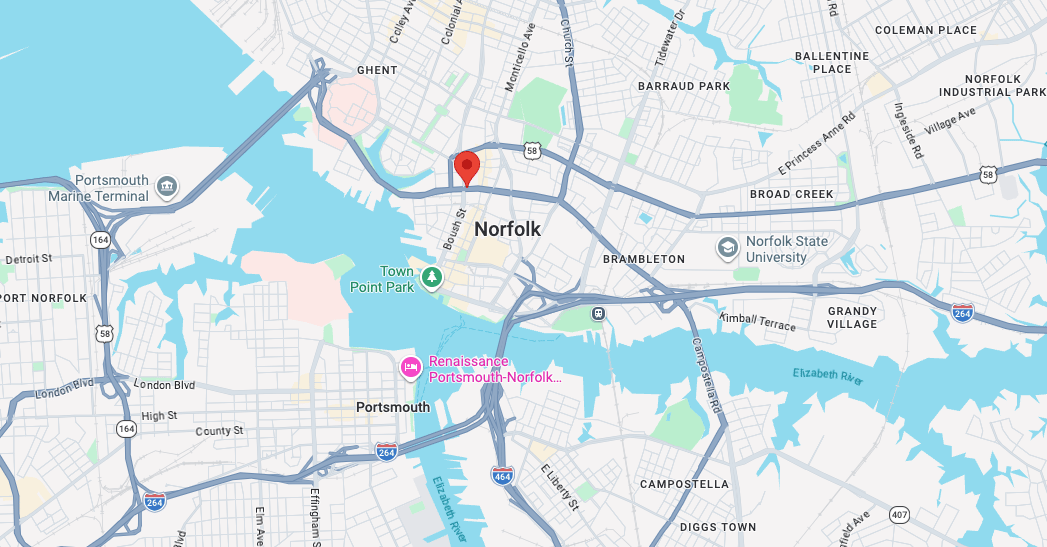
Find us at: 160 W Brambleton Ave. Norfolk, VA 23510
Call or text: 757-777-7777
Email: [email protected]
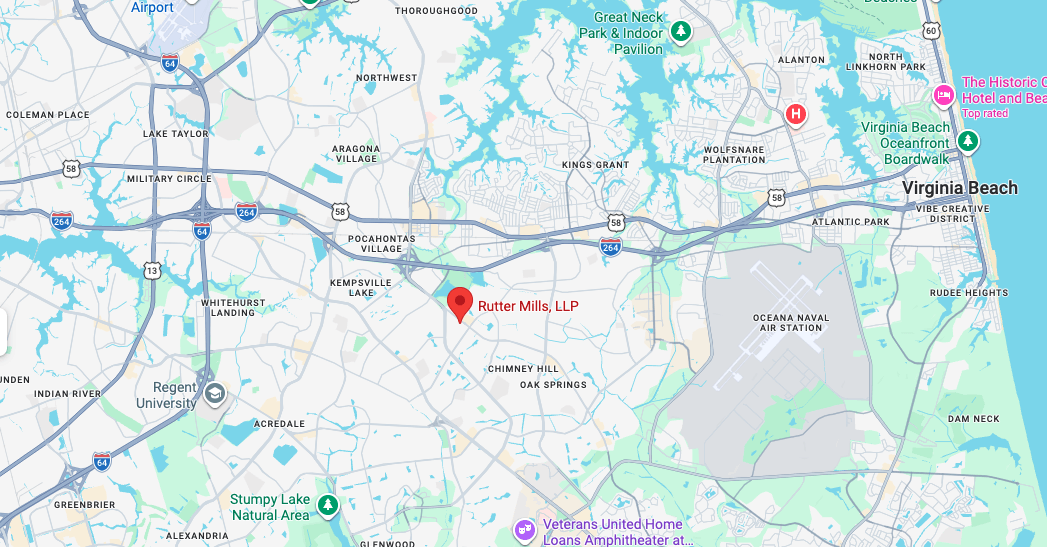
Find us at: 4287 Holland Rd. Virginia Beach, VA 23452
Call or text: 757-777-7777
Email: [email protected]
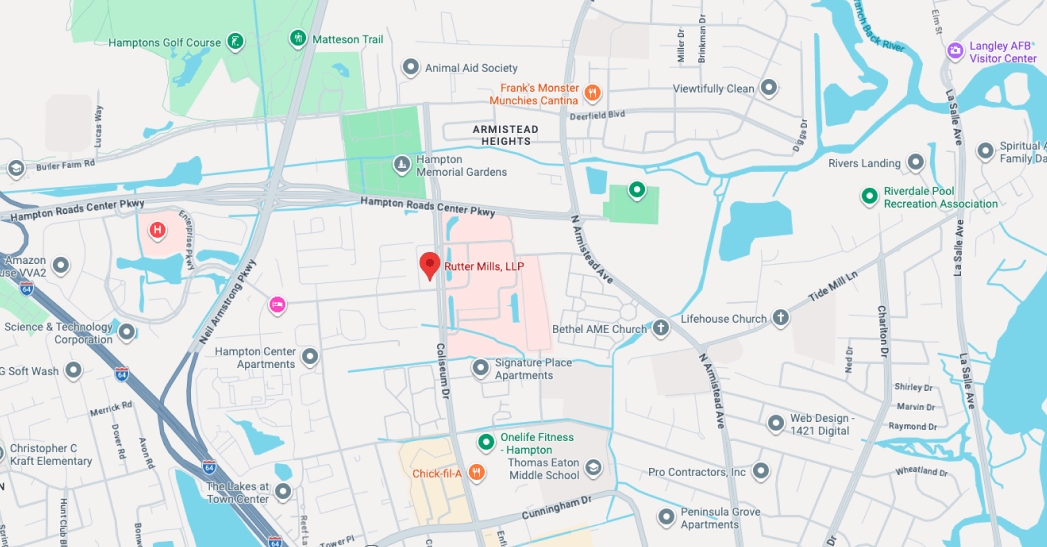
Find us at: 3001 Coliseum Dr, Hampton, VA 23666, United States
Call or text: 757-777-7777
Email: [email protected]
Coming in 2027
Find us at: 740 Eden Way, Chesapeake, VA 23320
Call or text: 757-777-7777
Email: [email protected]